
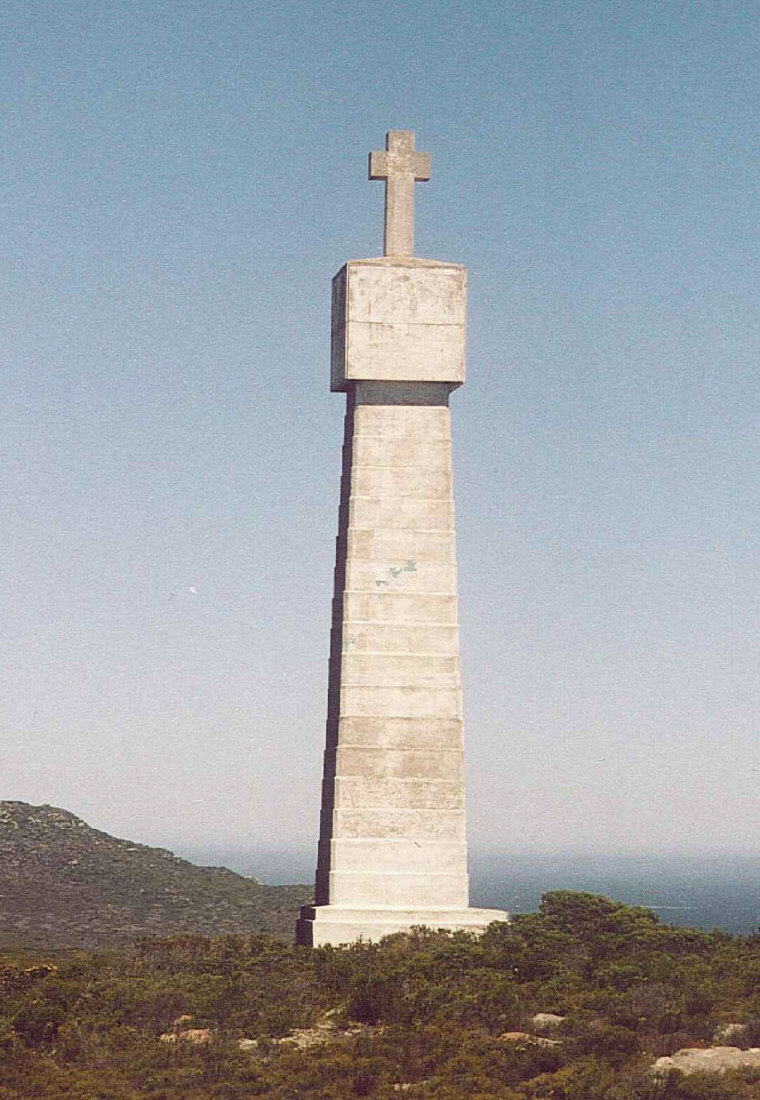
The white stone tower stands desolate on the horizon, trying to prevent the bright azure sky from falling into the ocean. A lonely and ultimately unsuccessful endeavor. A long gravel path winds its way through a vast meadow towards the structure. The land is one of stark contrasts. Charred black from recent forest fires on one side and vibrant green from blooming proteas flowers on the other. The fields fade away as the cliffs beckon. The Christian cross adorning the top of the structure comes into view. It appears to have distant lands within its crosshairs. We have arrived at Vasco Da Gama’s monument on the Cape of Good Hope.
The ancient rocks scattered around proudly show their scars from countless gales and crashing waves. They bear witness to the ships that came from Europe on their way to India and beyond. The wealth and the tragedy these stones must have seen. Centuries of stories observed from those beautiful wind-gouged cliffs. As I stand and soak it all in, I reflect on why this history is key to understanding much of the migrant crisis roiling the West today.
Chinua Achebe, the noted Nigerian novelist once remarked, “until the lions have their own historians, the history of the hunt will always glorify the hunter.” In its popular telling, the story of the rise of the Western liberal democracy is underpinned by the Renaissance and the Enlightenment. This version states that the thoughts of philosophers like John Locke and Jean Jacques Rousseau spurred the growth of democracy and the material and political success of the West. It is an incomplete version.
The part that is edited out or glossed over is more complex and less laudatory. For centuries the West never believed that Locke’s ideas of a natural right to life, liberty and property extended beyond its own citizens. Distant lands were colonized, their resources were plundered, and countless millions of people were shipped as slaves to help build or finance the flourishing democracies of the West. An example close to my conflicted heart illustrates the point.
St. Mary’s Church in Chennai lies in a bustling part of the southern Indian city. It is the oldest Anglican Church east of the Suez and the oldest British building in India. The first entry in its wedding register commemorates the betrothal of one Catherine Hymmer to the then Governor of Madras, Elihu Yale. This British merchant, historical records show, amassed a huge fortune through brutally suppressing local merchants and farmers and overseeing a lucrative and ruthless slave trade. How many of his ships rounded the Cape of Good Hope filled with India’s treasures? Yale went on to take some of that fortune made in and off India and endow one of America’s most prestigious universities. Yale’s story is not unique.
Walking down the streets of any major Western capital, one sees the edifices of our societies built partly on the foundations of the dispossessed from Africa, Asia and Latin America. This was the state the world found itself in at the beginning of the twentieth century. Successful liberal democracies were exploiting empires far beyond their borders to enhance the wealth and resources of their own citizenry. Fortunately, the colonial project crumbled under the weight of its immorality and the aftermath of two world wars, leading to the creation of modern nation states. When this geo-political template was finalized, the vast majority of the world’s people found themselves outside the national borders of the West, while the fruits of their historical wealth and labor lay within those Western nations.
The long term impacts of the colonial project lie at the heart of today’s migrant crises. A slow pace of poverty alleviation compounded by climate change (the industrialization of the West being a major contributor) are the biggest factors driving migration from poor countries to the West. Most of these nations have had less than a century to begin to correct the depredations of five hundred years. It is simply not enough time.
Poor nations share some of the blame for the slow progress in that they have yet to fully embrace the values of liberal democracy. In many instances these nations have relapsed into some of the pre-colonial dysfunctions that allowed colonialism to succeed in the first place. For example, I often wonder what rot must have existed at the heart of Indian society to allow a few thousand Englishmen to bring to heel the richest nation in the world. Yet it is hard to think that the people of these nations bear the entire burden of their current condition.
Americans, more than any other Western society, instinctively acknowledge their moral obligation in this regard. A country built on the paid and unpaid labors of willing and unwilling migrants has constantly provided more aid and accepted more immigrants than any other nation in the world. Even Elihu Yale’s tale has a redemptive arc. The university he funded is at the forefront of liberal thought in the United States and supports thousands of poor and immigrant students and employees. My own education and start in the United States was entirely funded by a very small portion of Yale’s ill-gotten fortune.
Much of America’s soft power is built on the premise that anyone from anywhere in the world is welcome and can succeed and assimilate here. Recently, however, we have begun flirting with some dangerous nativistic tendencies as the color and ethnicity of immigrants has changed. I am worried. Not only is this trend of ethnic nationalism economic malpractice in an aging society, but more importantly, it dims the intensity of the beacon that attracts the brilliant and the vulnerable to these shores.
Every time I see images of an immigrant across a real or imagined American barrier, I think about the connected history that began with the ships of Christopher Columbus and Vasco Da Gama. She may not speak the same language yet, but the migrant’s eyes implore me and say, “I come in peace to reclaim a little of what was mine, and I am prepared to work really hard to earn it.” I understand the plea because I made it once myself.
 Chats on the Charles
Perhaps some of the ‘dangerous nativist tendencies’ are a consequence of the failure of liberal democracy to live up to its ideals?
LikeLike
No doubt Peter. As resources get scarce people look to assign blame and demagogues find easy targets. Creating income growth at the bottom of the pyramid is the defining challenge of our times or the drift to extremism away from liberal democracy will continue.
LikeLike