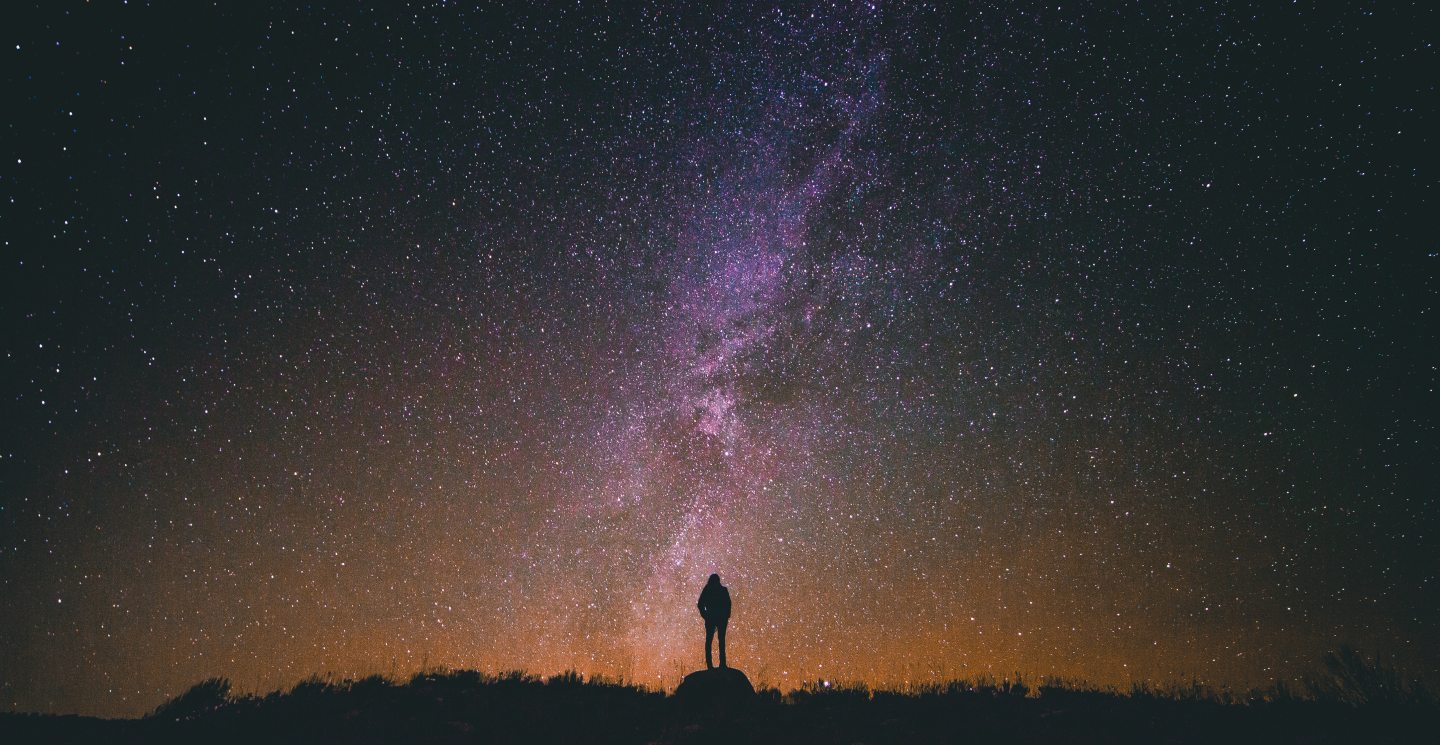
It was a typical North Indian winter night. The mountain wind, freed from the valleys and fortified with fresh Himalayan snow, was running wild across the plains. I found my seat on the rickety bus, unsuccessfully trying to close the rusted window. The long, cold and wet ride back home seemed daunting. Settling down for the six hour journey, I began leafing through my physics textbook, trying to get a head start on my holiday homework, but mainly hoping it would help me fall asleep. Dozing off and on, I barely felt the shoulder touching me.
A man, perhaps a few decades older, settled into the seat next to me. He was dressed in the clothes of an itinerant monk – a simple orange cloth on his body, red vermillion paste on his forehead, goose bumps on his exposed arms and prayer beads wrapped around his wrists. Turning to me, he asked, “Son where do you study?” Something about him seemed interesting. We began talking, two strangers, randomly acquainted on a bus to Chandigarh, and yet as I found out, on two completely separate journeys.
He listened as I told him about my studies at IIT Delhi, a hyper-competitive science and engineering institution. The unbridled enthusiasm of a cold and therefore animated 19-year old poured out. I described my passion for science, my acceptance into an American university to complete my college, and my getting that ultimate prize, a visa to study in the United States. Inevitably, our conversation turned to religion.
In the haze of 30-year old memories I don’t recall who started that discussion. Most likely it was me. Perhaps I was curious and asked him what he did. He said he had studied science as well and gave it all up to pursue spirituality in the Himalayan mountains. I learnt about an ancient order of Hindu monks who preach across India and then retire to the mountains to meditate and worship Shiva. The questions were multiplying in my brain as I contemplated his repudiation of everything I was about to embark on. And then he asked, “Do you believe in God?”
Relatively unscathed by the trials of time, those were my days of being a strident atheist. My drift away from God had started early, a teenage rebellion against my Catholic school education and the stifling Hindu religiosity around me. Rationality, logic and science were my guiding philosophies. God was an inconvenient intrusion into a beautiful universe. Unraveling the mystery of quantum physics was more interesting and remarkable than any epic or religious text I had read. As I laid out my youthful disdain, the man listened patiently, a smile creasing the sides of his face. Back and forth we went for a few hours. Soon the bus pulled into a town that was the staging ground for many Himalayan journeys. Above the usual din of tea vendors and trinket salesmen getting on and off the bus he remarked, “ I hope, for your sake, Planck’s Constant is a better guide through life than God.” And then he got up and walked off into the darkness.
As the years have gone by, I keep coming back to that conversation. Time has delivered its expected and unexpected share of triumphs, challenges and disappointments. Through all that, I have not needed to invoke a superior deity to cope with or enjoy life in all its richness and loss. The marvel of quantum physics, the possibilities of infinite universes, the intricacy of an atom or a gene, the power of an earthquake or hurricane, the complexity of nature and the evolutionary randomness of my very existence are as spiritual and awe-inspiring as anything the human creators of religion have conjured up.
My stridency has progressed into a benign agnosticism. Expanding my knowledge to the basic tenets of other faiths did not shed any new light on the monk’s statements. There simply is no evidence I can come across that points to a divine being. The adherents to faith keep asking for proof of the counterfactual – the non-existence of God. I am incapable of providing that. Hence my agnosticism.
My state of mind is best described in the words of Sam Harris, a philosopher, “I aspire for a level of intellectual honesty where I no longer pretend to be certain about things I am not certain about…and where personal convictions are scaled against evidence and where intellectual honesty is demanded equally in religious and non-religious views.” In that framework the Gods of our religions enable lazy rationalizations, and are an elixir to explain the random. They are unsatisfying in their relevance and uninspiring relative to the allure of science. It is no wonder that the vast majority of scientists are atheists or agnostics.
Most people do not share my views. They have a deep belief in their religion and its positive impact on their lives. I am envious of the steadfastness of their certainties, and yet my pursuit of soothing sustenance in those certainties has proved futile. Perhaps the joys and sadness yet to come will shake my convictions.
Recently I drove through the town where I last saw the monk. The bus station is still there, somewhat larger and more modern, and still a beehive of activity. Was he on to some truth that I have struggled to see? Would my life be different if I had stepped off that bus with an acceptance of religion? I do not know. Rationality dictates that I will remain open to the evidence of the existence of God. Until then, to paraphrase the words of the saints of Liverpool, “When I find myself in times of trouble, Planck’s Constant comes to me, speaking words of wisdom, let it be let it be.” This version may not quite have the angelic beauty of Mother Mary, but it is comforting, nevertheless, in its truthfulness.
 Chats on the Charles

I have often wondered if science is best suited for our enagagment with the natural order and religion (though I prefer the word spirituality) for our engagement with the social order. It is so much more intellectually compelling and satisfying to explore the natural order through the theories of physics, chemistry, and biology than to invoke God as the creator of all nature (even if science cannot readily answer the most fundamental questions of who created the Big Bang or the first life forming material from which evolutionary dynamics began). On the other hand, when it comes to questions of the social order such as how should one live a good life, which provides personal meaning and productive interactions with other members of society, the wisdom of the sages provides much more to ponder, from the universality of the golden rule (do unto others as you have done to yourself), to how one might find joy and happiness in life. The social sciences have some lessons to offer in this regard (such a the law of reciprocity, you are likely to be treated by others as you treat them), but the ideas in the religious texts are often so much richer, nuanced, and yield more insight upon contemplation and reflection.
Where does that leave me. I have stopped worrying about the labels of religious, atheist, or agnostic. I simply view science and spirituality as two different bodies of knowledge, each of which is better suited for my own understanding of different aspects of the world I inhabit.
LikeLiked by 2 people
Thank you Nitin for your thoughtful response. The question that I struggle with is this: does one need organized religion to avail of the wisdom of these critical social and moral rules? And does it make up for all the costs of blind adherence to faith. As you say, as long as one comes to having that right balance, how they get there is less relevant. Thanks again.
LikeLike
Funny that I made essentially the opposite journey – from an agnostic in my IITD days to a more-or-less atheistic position now. The issue is simply one (to me) of agency – generally one assumes that ‘God’ implies some type of intent/agency. If not, then whether one calls it God or Nature or the ‘unfolding of the cosmos’ or whatever, really makes no difference. Back in college, I was in a cheerful (?) state of ignorance i.e. I was aware of the issues but didn’t think I knew enough to take a position on them. Now however, it seems increasingly hard (to me) to ascribe anything to a universe-wide intent, hence the drift toward atheism. Anyway, in a few years the question will be moot for this being 🙂
LikeLike
Thanks for sharing Vik. Very interesting and a topic for sure to spur healthy debates. In my simplistic mind I always felt that, science is there for you to break the boundaries, explore and let you fly high, religion is there to instill discipline and keep you plugged to the ground. I see them as two sides of a coin that keeps the balance in life and world at large. Similar to how Science can be used to generate nuclear power and nuclear bombs religion can be used to instill peace and harmony as it is to destroy human kind through spread of hatred. Lastly, my dad always used to say, “what is proven and explainable is Science and what is not explainable is gods creation, whatever the religion you may follow.”
—
LikeLike
Plancks constant is the arbitrary stopping point in the investigation into the fractal world of chaos. Faith in science is based on the illusion of having found somthing, when in reality we just stopped searching. Meanwhile we build additions to our world by always finding what we assume.
LikeLike
Vik, your best blog ever. Keep writing, it’s a treat to read your words,
LikeLike
Relevant discussion points as I see them.
On Faith: Godel mathematically proved (i.e. for any consistent system) that truth exists that can’t be proven. That means rationality/logic shows that it cannot, by its own rules, possibly access all the truth that exists. That means, I think, to access all truth, we need a degree of faith of some kind. Interesting that it’s actually possible to rationally show that truth exists that can’t be proven.
On Creation: Whatever ‘caused’ (created?) what we observe was immensely powerful, and above/beyond/outside of space or time. Science itself shows that that this creation is extremely finely balanced (Planck’s constant just one example) to allow matter, particles, chemistry, etc to exist/function. That creation made life. That life is conscious, intelligent, has free will, cares about morality, and can Love. If this wasn’t all create created, it sure seems like, and if it is random then we are very lucky – not too dissimilar to drawing a royal flush every hour of every day. If it is random then cannot have a purpose beyond reproduction – which I’m not sure even fits the definition of a purpose.
On science v. God, The Language of God – by Collins (head of the US human genome project) present, and Evidence that Demand a Verdict – by McDowell – present good, rational discussions of this issue.
The existence or non-existence of any God isn’t up to the mind of any human. If He exists, He exists no matter what anyone thinks. If He doesn’t exist then it is people are (as you say) conjuring Him up.
My faith – it is a faith, like faith is the climbing rope – is that God does love us so much that he sent His Son, and by His grace (unearned gift) offers us a fuller life now by loving each other, and the hope of eternal life. You can try this out yourself – I recommend it, but I can’t prove it.
Of course, alternative explanations exist – including this all being a dream. That‘s why it’s a matter of faith. A God who loves and cares for each of us would be good news. I random, pointless world would be bad (even sad) news.
I congratulate your honesty in bringing up this topic – it is really the most important question we all face… and we’ll each find out the answer much too soon, and have the question definitively answered or nothingness.
Like a cartoon I saw once… two guys looking at the stars at night. One says “Really makes you think”. The other replies – “Yeah… we are so big and important, and they are so small and insignificant”.
LikeLike