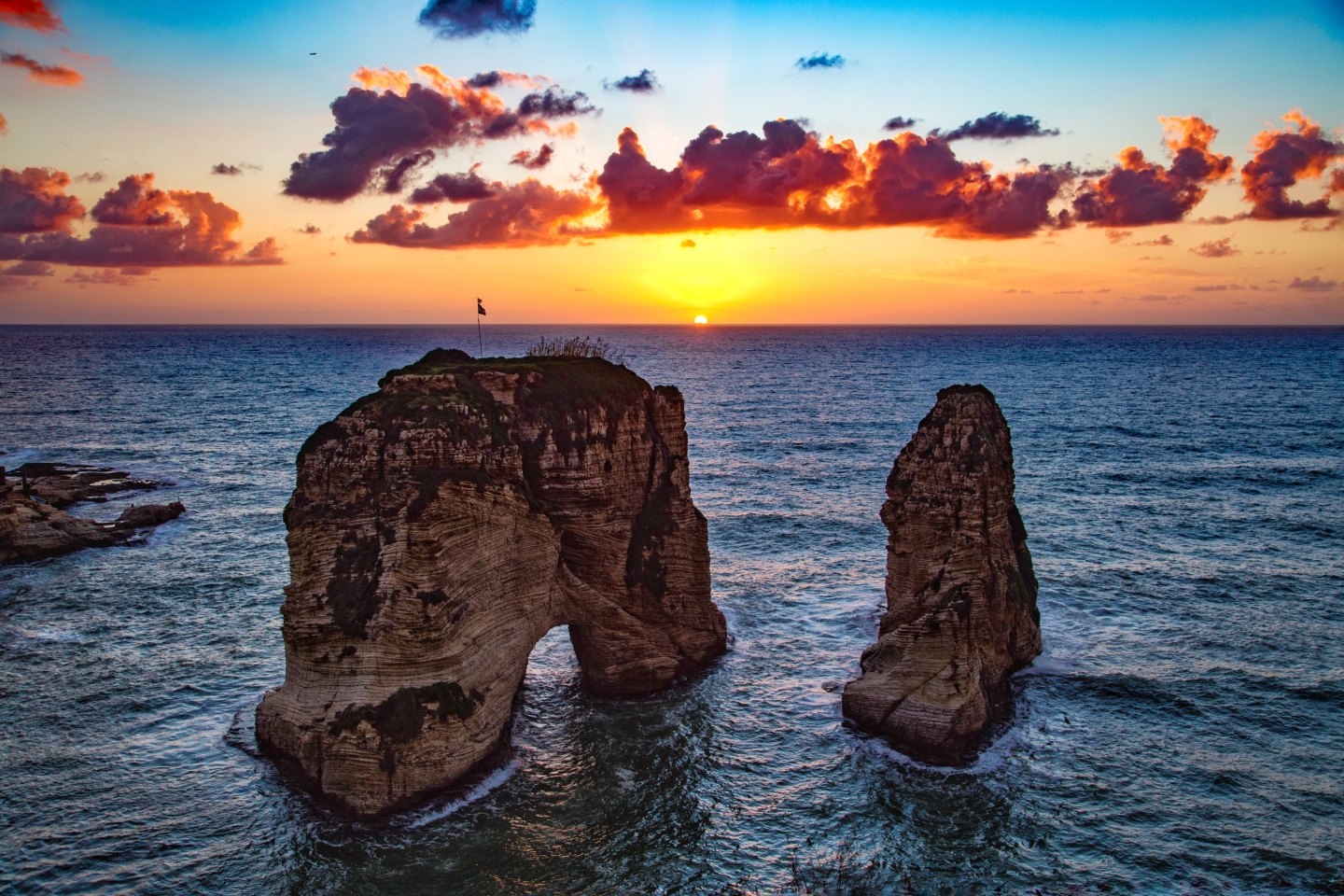
Yesterday I went back to Beirut, cinematically at least. This city on the shores of the Mediterranean has long fascinated me. My father told me stories of his time teaching at The American University and visiting the spectacular caves near the city. It was also the first place outside India I ever visited, although that visit barely qualifies. The Air India flight taking my mother and me to New York in the mid 1970s was scheduled to make a stop in Beirut. I vaguely remember landing early morning at Beirut International Airport, the plane taxiing to an abrupt stop, and then taking off immediately, with some urgency. Years later I learnt that was the time a militia in the Lebanese Civil War threatened to shell the airport.
My love for global affairs was also kindled by a book, partially about this city. I read From Beirut to Jerusalem in college and became fascinated by the intersection of history, culture and politics in the Middle East. Decades later the book’s author Tom Friedman, remains the pre-eminent analyst of the region.
As we try and understand the rationale for the missile strikes in Syria this past Friday, reading Tom’s latest analysis and watching Beirut, the movie, are good places to start.
The movie, released last week, highlights the historical context in which the United States operates in the Middle East. It is a wonderful, fast-paced thriller. Every character and institution in the movie is deceiving everyone else. American, Lebanese, Israeli, Syrian and Palestinian interests concoct a combustible mix – the parallels to today are eerie. The movie ends by quoting Ronald Reagan, “With patience and firmness we can help bring peace to the war-torn region.” That was more than forty years ago.
Tom’s latest piece in The New York Times is also mostly on point. He argues that the missiles were a side show and the real confrontation in Syria is between Iran and Israel. He, however, underestimates the strategic importance of Syria for the Russians and the Iranians. Putin’s regime needs high energy prices to survive. Permanent Russian bases within close range of the Gulf is a not so subtle reminder to the Arab monarchies about the benefits of cooperation in energy markets. Similarly, the Shia leaders in Iran view a land bridge to the Mediterranean as an invaluable alternate access to the sea, should conflict with the Sunni monarchies of the Gulf choke off the Straits of Hormuz. Worryingly, Friedman thinks that a conflagration is imminent. If that transpires, what would the West do?
In recent years, the United States has rightly de-emphasized the strategic importance of the Middle East. Our energy independence makes the area much less critical to our interests. Keeping the sea lanes of the Gulf of Aden and the Suez Canal open, containing terrorism, and maintaining a security alliance with Israel were our new priorities. However, if a major war breaks out, it will not be confined to Syria and will quickly involve the entire region, including Lebanon. Will we be able to stay out? As in the movie, Beirut has a beguiling ability to suck one into its web, over and over again.
 Chats on the Charles
Leave a comment